
Mystical Tutor | What's the Best MTG Format for Beginners?
- Greg Montique

- Mar 2
- 8 min read
If you're asking what's the best MTG format for beginners, you're already asking the right question, and the fact that it needs asking says a lot about Magic: The Gathering. Because here's something nobody tells you upfront: Magic isn't one game. It's about a dozen games that all use the same cards and rules but feel completely different depending on the format.
Someone handed you a card, you watched a game and thought "that looks fun," or maybe you just enjoy collecting things that slowly drain your bank account. Whatever brought you here, welcome. Magic is one of the deepest, most rewarding games ever made — and this guide will make sure you don't accidentally wander into the deep end before you've learned to swim.
We'll walk you through every major format, who it's best for, what it costs, and what it actually feels like to play. By the end, you'll know exactly where to start.
First, What Even Is a Format?
A format is a ruleset that defines which cards are legal to use and how you build your deck. Think of it like sports: basketball and water polo both involve a ball, but you wouldn't show up to a basketball game in a Speedo.
Some formats restrict you to newer cards only. Some let you use any card ever printed. Some have you building decks before you arrive; others have you building on the spot. Some are one-on-one, others seat four players around a table for a chaotic, alliance-forming, backstabbing good time.
The format you choose shapes everything: how much money you spend, how competitive games feel, how long they last, and whether you have fun or feel like you're getting run over by a truck.
The Best MTG Formats for Beginners, Ranked and Explained
Commander (EDH) — The Best MTG Format for New Players
Best for: Almost everyone, but especially beginners who want a social, low-pressure experience

Commander is the most popular Magic format in the world right now, and for good reason. It's a multiplayer format, typically four players, where each person builds a 100-card singleton deck (meaning only one copy of each card, except basic lands) built around a legendary creature called your Commander. That Commander sits in its own special zone and can be cast over and over throughout the game, giving your deck a consistent identity and personality.
Games are free-for-all. Everyone is a threat. Everyone is a potential ally. And because the table naturally focuses on whoever looks like they're about to win, newer players get a lot more breathing room than in one-on-one formats. Nobody is zeroing in on you specifically, at least not yet.
The social element is a huge part of the appeal. Commander games involve deal-making, table politics, dramatic comebacks, and moments that people talk about for weeks. It's less about optimized plays and more about memorable experiences.
What it costs: Commander decks can cost anywhere from $30 (using a preconstructed deck straight out of the box) to several thousand dollars if you go deep down the rabbit hole. Wizards of the Coast releases official preconstructed Commander decks regularly that are genuinely playable right out of the box, making this one of the most accessible entry points in terms of setup.
How long games last: 90 minutes to 3 hours +. Yes, really. Clear your schedule.
The catch: Because it's multiplayer and games run long, Commander isn't great for quick sessions. It also rewards political savvy and social reading as much as technical play, which some people love, and others find frustrating.
Draft — The Best MTG Format for Beginners on a Budget
Best for: Beginners who want a level playing field and don't want to invest in a collection yet

Draft is arguably the purest Magic experience. Everyone sits down with no cards. You open booster packs, pick one card, pass the rest to the player next to you, pick again, and repeat until the packs are empty. Then you build a deck from what you picked and play.
This format completely eliminates the pay-to-win problem. Nobody walks in with a deck they spent $800 on. Everyone is working with the same randomness, the same constraints, and the same on-the-fly decision-making. It also teaches you card evaluation, deckbuilding instincts, and strategic thinking faster than almost any other format.
Most local game stores (LGS) run weekly Draft events, often called Friday Night Magic. They're welcoming to new players, usually cost around $15 to $20 to enter (which covers your booster packs), and you keep the cards you draft.
What it costs: $15 to $30 per event, and you keep what you open and draft. Over time, you naturally build a collection without buying anything separately.
How long games last: 20 to 40 minutes per match, with a tournament usually running 3 to 4 rounds total.
The catch: You're building a deck from whatever you happen to open and pick. If you love having a plan, the chaos might feel uncomfortable at first. It gets easier fast.
Sealed — A Great MTG Format for Tournament Players
Best for: Beginners who like Draft but want more time to think about their deck
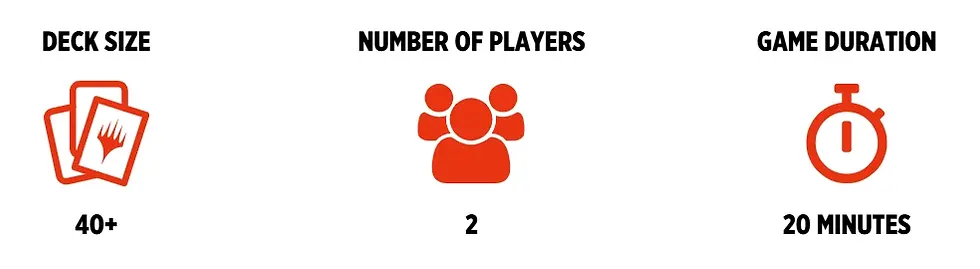
Sealed is Draft's more relaxed cousin. Instead of drafting cards one at a time, each player opens six booster packs and builds a deck from those 90 cards alone. No passing, no picking under pressure. You lay everything out, figure out what you've got, and build the best 40-card deck you can.
Sealed is the format used in most large Magic tournaments and prerelease events. Prereleases happen every few months when a new card set releases, and they're specifically designed to be beginner-friendly. Store staff usually walk new players through the process, and the atmosphere is celebratory rather than cutthroat.
What it costs: $25 to $35 for a prerelease event. You keep all six packs worth of cards.
How long games last: Individual matches run 30 to 50 minutes.
The catch: Your deck quality is entirely at the mercy of what you open. Sometimes you open a spectacular pool. Sometimes you open a pile of confusion and make the best of it. Both are part of Magic.
Standard
Best for: Players who want a competitive constructed format with a manageable card pool

Standard uses only cards from the most recently released sets, rotating roughly once a year as older sets leave the format. The result is a smaller, more defined card pool that's easier to learn than older formats, and the one most commonly featured on Magic's official competitive circuit.
What it costs: Budget Standard decks exist in the $50 to $100 range. Top-tier competitive decks often run $300 to $500.
How long games last: 20 to 30 minutes per match.
The catch: Rotation. When older sets leave Standard, cards you've invested in may no longer be legal. The upside is those cards often hold value in other formats.
Pioneer
Best for: Players who want more depth than Standard but without the price tag of older formats

Pioneer includes cards printed from 2012 onward, striking a middle ground: more powerful and diverse than Standard, less brutally expensive than Modern or Legacy. It's a natural stepping stone once you've found your footing.
What it costs: Competitive Pioneer decks typically run $150 to $400. Budget options exist but require more creative deckbuilding.
How long games last: 20 to 30 minutes per match.
Modern
Best for: Experienced players who want a deep, powerful, established competitive format

Modern includes cards from 2003 onward. The card pool is enormous, the decks are powerful, and games can end very quickly. This is not where you want to start. Come back once you've played Magic for a while and know what kind of player you are.
What it costs: $400 to $1,500 or more. This is not a typo.
Legacy and Vintage
These formats go all the way back to Magic's origins. They are spectacular to watch, deeply interesting to study, and absolutely not where new players should begin. Competitive Legacy decks routinely cost $2,000 to $5,000. Vintage decks can exceed $10,000.
Bring these up at a game store, and experienced players will nod reverently. Start here, and you will have a bad time.
Pauper — The Best MTG Format for Beginners on a Budget
Best for: Budget-conscious players who want a competitive constructed format

Pauper is a format where only common-rarity cards are legal. No rares, no mythics, just commons. The result is a surprisingly deep and competitive format that costs almost nothing to get into, with most competitive decks running between $20 and $80. Don't let the budget nature fool you — Pauper has a passionate community and games that require real skill.
What it costs: $20 to $80. The most budget-friendly constructed format in the game.
The catch: Pauper events can be harder to find at local stores. MTG Arena and Magic Online are often the easiest ways in.
Digital Options: MTG Arena and Magic Online
Before buying a single physical card, know that Magic has two official digital platforms.
MTG Arena is free to play, beautifully designed, and the single best way for beginners to learn MTG formats without spending any money. It teaches you through a tutorial, enforces rules automatically, and lets you play at your own pace. Start here if you're not sure whether Magic is for you.
Magic Online (MTGO) is older and costs money, but supports nearly every format, including Legacy and Vintage. Serious competitive players use it to test and grind.
So, Which MTG Format Is Best for You as a Beginner?
You have friends who already play: Join whatever they're playing. Format familiarity matters less than having people to sit across from.
You want to try Magic for free: Download MTG Arena. It's excellent.
You want to dive into physical cards: Go to a prerelease or Friday Night Magic Draft at your local game store.
You want a casual, social experience: Commander with a preconstructed deck. Buy a precon and sit down.
You want competitive play without spending a fortune: Pauper for constructed, Draft for limited.
You want the full competitive experience: Start with Standard, then move to Pioneer.
A Few Things Nobody Tells Beginner MTG Players
You will lose a lot at first, and that's fine. Losing games teaches you more than winning does early on.
Your local game store is your best resource. Walk in, say you're new, and ask questions. Most stores have beginner nights and staff who genuinely enjoy helping.
Don't buy random booster packs to build a collection. It feels satisfying, but it's an inefficient way to get cards. Buy singles for specific decks, play Draft to build a collection organically, or start with preconstructed products.
The rules are more learnable than they look. Magic has a lot of rules, but most games use a small fraction of them. Learn as you go.
The community is mostly great. Find your people and the game opens up considerably.
The Bottom Line: The Best MTG Format for Beginners
Start with Commander using a preconstructed deck, or jump into MTG Arena to get your footing for free. From there, let your interests guide you. Maybe you'll fall in love with the competitive grind of Standard. Maybe you'll spend every Friday night drafting at your local store. Maybe Commander becomes a weekly ritual with the same group of friends for the next decade.
Magic has been around since 1993 because it's genuinely remarkable. Give it a real chance, and there's a good probability it'll become one of your favorite hobbies. Just don't say we didn't warn you about the card buying.


Comments