
The Grand Line Shifts: The March 2026 One Piece TCG Ban List Announcement

One Piece Card Game - Competitive Update | Effective April 1, 2026
Bandai dropped a pretty significant bombshell at the March 16, 2026 Card Games Fest, a sweeping ban list update paired with the game's very first block rotation. With one high-profile card banned, six freed from the restricted list, and Block 1 officially rotating out of Standard, the One Piece TCG is entering a fundamentally new era. Let's break it all down.
The Ban: Charlotte Pudding (OP06-047)
Pudding has dominated decks that include black cards since her release, and Bandai finally pulled the trigger. She is a blue 4-cost Character whose On Play ability forces your opponent to shuffle their entire hand back into their deck, then draw five cards. On the surface, that sounds like you're helping your opponent, but the reality is that resetting a handful of carefully held counters and situational cards while replacing them with a random five is an incredibly disruptive play that consistently swings the game in the Pudding player's favor.
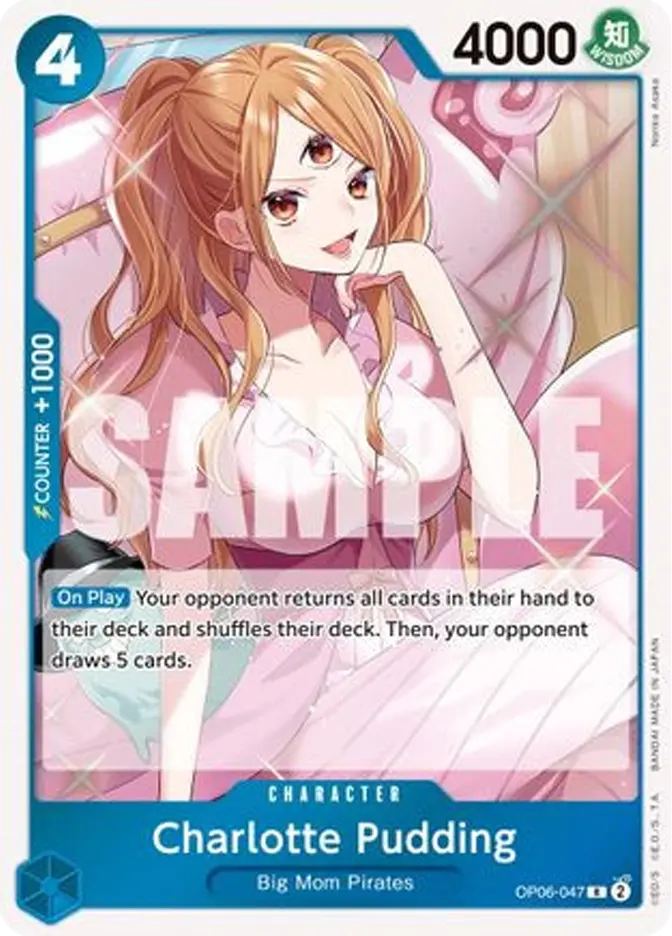
The community had been calling for this ban for a while now, and the reasoning from Bandai is pretty clear. Pudding had no restrictions on which Leader she could be played with, meaning she could slot into virtually any deck running black cards without the usual deck-building cost. She was too flexible and too swingy to keep around.
The interesting thing here is how Bandai chose to act. A lot of players had been pushing for a softer touch, locking Pudding to a specific Leader type rather than banning her outright. Instead, the hammer came down hard. That tells you Bandai felt no partial restriction would adequately contain her impact going forward, especially as newer sets continued to print powerful cards that made the hand-reset effect even more punishing.
The Unbans: Six Cards Return
Six previously banned cards have been freed, but context is everything here. The majority are Block 1 cards, meaning they rotate out of Standard format on the same date they're unbanned. This is really more of a clean-up move than a meta shake-up. That said, it's still worth knowing what each card actually does and why it was banned in the first place.

Jinbe (OP07-045)
Jinbe is a blue 4-cost Character with 5000 power whose On Play ability lets you play up to one Seven Warlords of the Sea type Character with a cost of 4 or less from your hand for free. Bandai banned him because, in combination with Leaders like Doflamingo or Teach, he allowed players to flood the board with multiple characters far too early in the game, creating one-sided matches from the jump. He is actually a Block 2 card, so he remains legal in Standard post-rotation.
Kingdom Come (EB01-059)
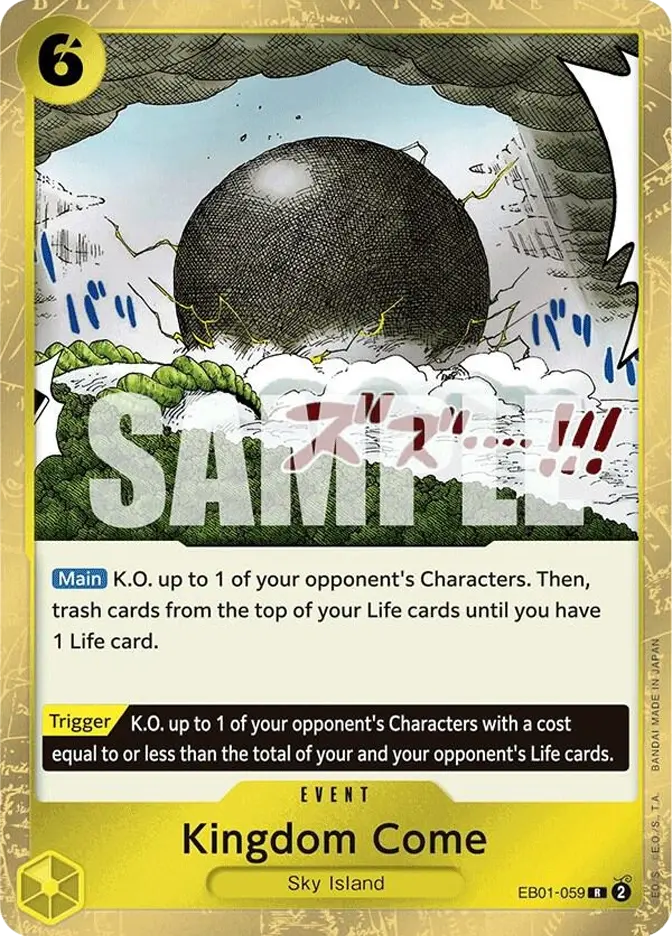
Kingdom Come is a yellow 6-cost Event with a powerful Main effect that K.O.s one of your opponent's Characters, then trashes your own Life cards down to just one remaining. Its Trigger effect K.O.s one of your opponent's Characters whose cost is equal to or less than the combined total of both players' Life cards. When combined with the Enel Leader, this created a defensive and removal-heavy game plan that Bandai felt was too strong and was starting to limit future card design for high-cost Characters.
Great Eruption (ST06-015)
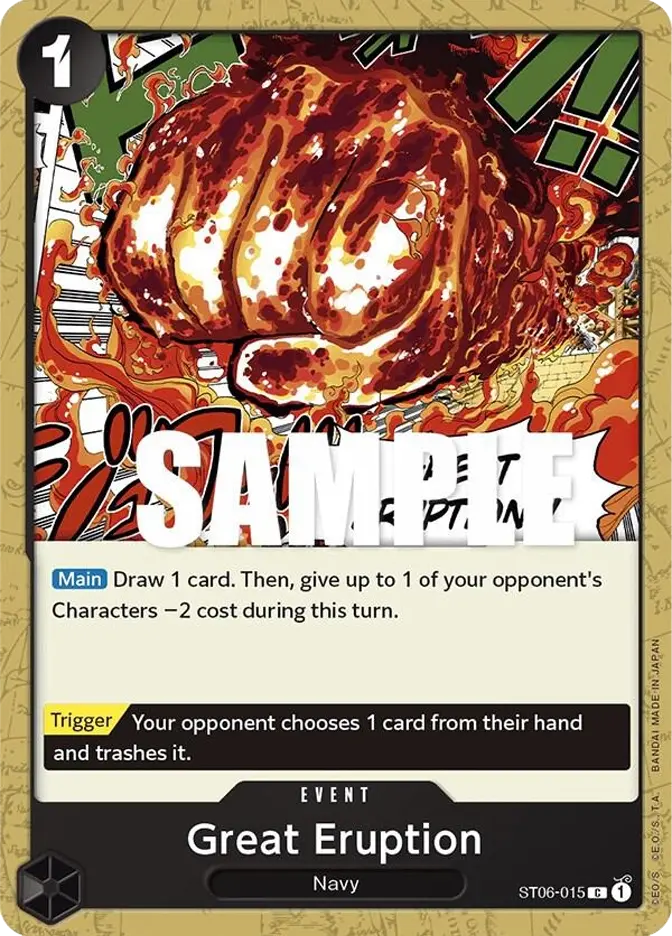
Great Eruption is a black 1-cost Event that draws you a card and then gives one of your opponent's Characters a -2 cost reduction for the turn. Its Trigger makes your opponent discard a card from their hand. For just one Don, the combination of card advantage, cost reduction to enable your own removal, and hand disruption on the Trigger was considered too efficient and too consistent in black control decks, particularly those abusing cost-reduction combos.
Moby Dick (OP02-024)
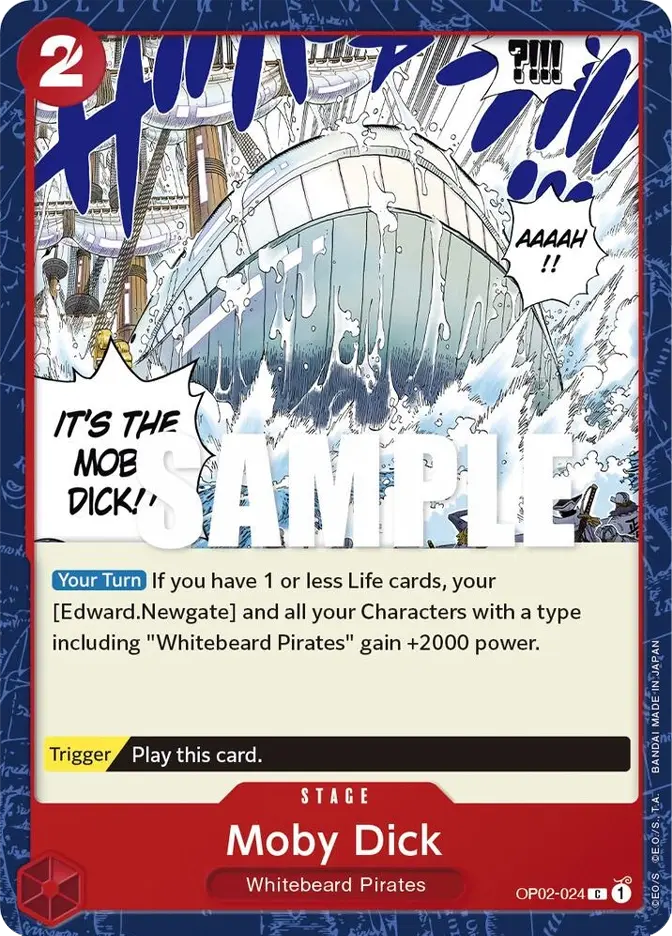
Moby Dick is a red 2-cost Stage that, on your turn, gives Edward Newgate and all your Whitebeard Pirates Characters +2000 power as long as you have 1 or fewer Life cards. It also has a Trigger that lets you play it directly from the Life area. The combination of a cheap cost, a self-triggering condition that Whitebeard decks naturally wanted to reach, and a free placement Trigger made it too easy to establish a permanent power boost that opponents couldn't cleanly answer.
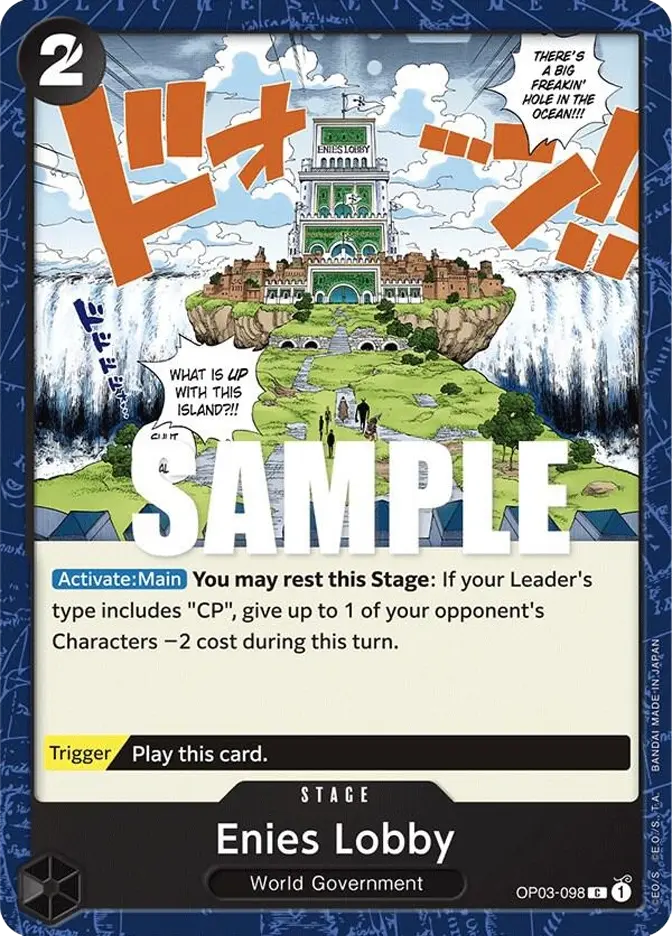
Enies Lobby (OP03-098)
Enies Lobby is a black 2-cost Stage with an Activate: Main ability that, if your Leader has the CP type, lets you rest it to give one of your opponent's Characters a -2 cost reduction for the turn. It also has a Trigger to play itself. The issue was that once it hit the field, it could consistently reduce the cost of powerful opponent Characters, enabling Rob Lucci decks to pick them off repeatedly and cheaply across multiple turns in a way that was nearly impossible to come back from.
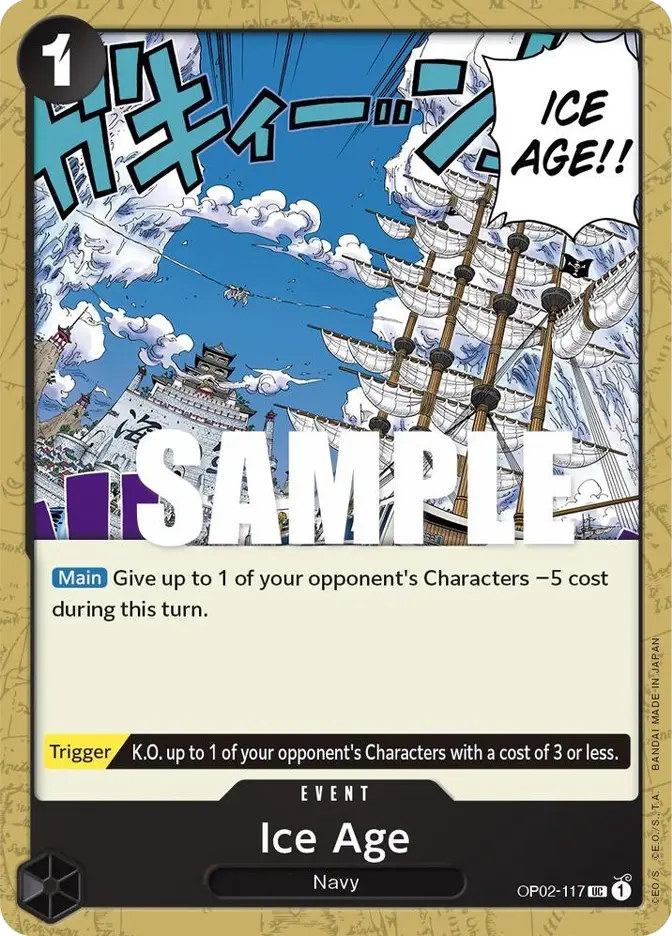
Ice Age (OP02-117)
Ice Age is a black 1-cost Event that reduces one of your opponent's Characters by 5 cost for the turn. Its Trigger K.O.s one of your opponent's Characters with a cost of 3 or less. For a single Don, reducing a massive opposing Character down to zero cost effectively makes it a free K.O. target for even the cheapest removal in the game. It was considered too efficient and too flexible, giving black and navy decks a near-costless answer to anything on the board.
The bottom line here is that while it's satisfying to see these cards cleared, their practical impact on Standard play is mostly zero. They live on in Eternal format, where they might fuel some nostalgic, high-power casual builds, but competitive players won't be sleeving most of them up for regionals.
Block Rotation: A New Era for Standard
This is the truly transformative change in this update. Starting April 1, 2026, the One Piece Card Game introduces its first-ever block rotation, a system that longtime Pokemon TCG or Magic: The Gathering players will recognize immediately.
Every April, the oldest block rotates out of Standard, keeping the meta fresh and preventing any one era of cards from permanently dictating the format.
Here's how the blocks shake out:
Rotating Out: Block 1, covering OP01 to OP04 and ST01 to ST09, is now Eternal only going forward.
Now Oldest Legal: Block 2, covering OP05 to OP08, EB01, and ST10 to ST14, is the new floor for Standard.
Standard Legal: Block 3, covering OP09 to OP12 and ST15 onwards, remains fully legal.
Newest Block: Block 4, covering OP13 to OP16, is of course legal as well.
Bandai has indicated that reprints of key staple cards may appear in future sets to ensure essential effects remain accessible in Standard. That's a smart design safety valve and means that players won't be entirely stranded when their favorite effects rotate out.
It's also pretty clear that the timing of the unbans and the rotation are directly linked. Why keep bans active on Block 1 cards when they're leaving Standard anyway? The unbanned cards are effectively a parting gift, giving players the chance to run them in Eternal format events without the ban list stigma hanging over them.
Meta Implications: What Changes?
With Pudding gone and Block 1 rotating out, the meta heading into April 2026 is genuinely wide open. Here's what to keep an eye on.
Black Decks Take a Hit: Pudding was the hand-reset engine that black-splash strategies across a huge variety of Leader types relied on. Without her, those decks lose their most flexible disruptive tool. You can expect black to drop a tier or two in consistency until players find a replacement package. The ceiling for black strategies is still there, but that automatic game-swinging effect is gone and decks are going to feel it.
Jinbe and Doflamingo Remain Relevant: Since Jinbe sits in OP07, he is a Block 2 card that stays legal in Standard. That means the free Seven Warlords placement ability is still very much in the format. Doflamingo strategies could remain genuinely dangerous and should absolutely be on your radar when testing.
Block 2 Decks Come Into Their Own: With Block 1 gone, decks built around OP05 to OP08 Leaders are now the baseline of the format rather than just one option among many. Enel, Sakazuki, and other Block 2 powerhouses suddenly define the meta ceiling. Expect a lot of deck testing and reshuffling as players figure out where everything lands.
New Player Accessibility Gets a Boost: One underrated benefit of rotation is that newer players no longer need to hunt down OP01 to OP04 sets just to stay competitive. The barrier to entry drops in a meaningful way, and the format becomes a lot easier to learn without four blocks worth of card interactions to keep track of. That's genuinely good for the game's long-term health.
Eternal Format Gets More Interesting: With six cards unbanned and all of Block 1 now Eternal-legal, cards like Ice Age, Great Eruption, Moby Dick, and Enies Lobby can finally run together in their full glory. If your local store runs Eternal events, expect to see a surge of creative and high-power deck submissions showing up at the table.
The Verdict On the One Piece Ban Update
This is one of the most consequential update packages the One Piece Card Game has seen since launch. Pudding's ban removes a hand-disrupting engine that had no real counters and no deck-building cost attached to it. The unbans are largely ceremonial but appreciated. And the block rotation fundamentally changes what it means to build and play a competitive deck going forward. The Grand Line just got a lot more unpredictable, and honestly, that's exactly what the meta needed.


Comments