
Mystical Tutor | What is the MTG Commander Bracket System?

If you have ever sat down for a casual Commander game only to watch someone combo off on turn three while everyone else is still playing lands, you already understand why the MTG bracket system exists. Wizards of the Coast introduced the bracket system in 2025 as the official way to help Commander players judge how powerful their deck is before the game even starts. Think of it as a rating system for your deck, except instead of Yelp stars, it determines whether you are about to have a fun Friday night or a deeply humbling experience.
And if you heard about the bracket system when it first launched and tuned out, it is worth checking back in. The Commander Format Panel released a significant beta update in October 2025 that changed bracket names, removed tutor restrictions, overhauled the Game Changers list, and added a whole new bracket. There is a lot to catch up on.
Why Does the MTG Bracket System Exist?
Commander has always had a problem that no one wanted to admit out loud. The format spans thirty years of card history, supports decks built with five dollars or five thousand dollars, and somehow expects four strangers to sit down and have a balanced, enjoyable game with no prior conversation. Predictably, this did not always go well. The bracket system exists because "casual" means something very different to the person running Swords to Plowshares and the person running Thrasios and Tymna with a full cEDH package. Now there is an actual framework to sort that out before anyone shuffles up.
How Does the MTG Bracket System Work?
The bracket system divides Commander decks into five tiers, numbered one through five. Each bracket represents a general power level, play style, and roughly how many turns you can expect a game to last. The idea is that players should try to match brackets at the table for the most enjoyable game. Here is what each bracket actually means.

Bracket 1: Exhibition
Exhibition is all about theme over function. Decks in this bracket prioritize a goal, theme, or idea over power, and win conditions are highly thematic or deliberately substandard. This is the bracket for the person who built a deck entirely around one specific flavor of frog tribal and wants everyone to appreciate the vision.
Generally, you should expect to play at least nine turns before anyone wins or loses. Nobody is in a hurry here.
Bracket 2: Core
Core decks are unoptimized and straightforward, with some cards chosen to maximize creativity or entertainment. Win conditions are incremental, straightforward, and disruptible, and gameplay is low-pressure with an emphasis on social interaction, you know, the fun part of the game. This is the sweet spot for most kitchen table Commander groups. You should expect to play at least eight turns before anyone wins or loses.
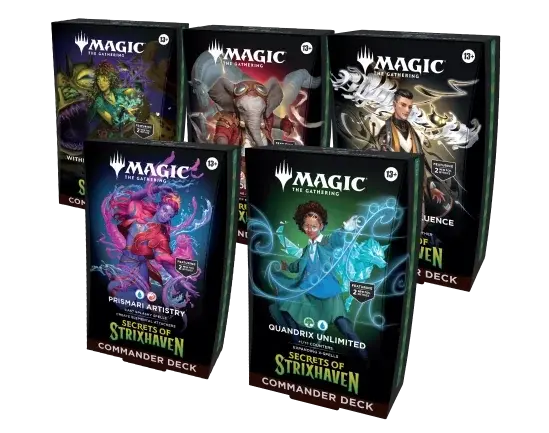
One notable update from October 2025: Core is no longer tied directly to precon Commander decks as a benchmark, since precons vary so widely in power level that the comparison was causing more confusion than clarity.
Bracket 3: Upgraded
Upgraded decks are powered up with strong synergy and high card quality and can effectively disrupt opponents. Win conditions can be deployed in one big turn from hand, usually due to a steady buildup. This is where things start getting serious and where knowing your opponents' decks actually matters. Expect to play at least six turns before the game ends.
Bracket 4: Optimized
Optimized decks are lethal, consistent, and fast, designed to take opponents down as quickly as possible. Game Changers here are likely to be fast mana, snowballing resource engines, free disruption, and tutors. This is not quite full cEDH, but it is pointed firmly in that direction. Expect to play at least four turns before the game ends.
Bracket 5: cEDH
cEDH decks are meticulously designed to battle in the competitive EDH metagame, with the ability to win quickly or generate overwhelming resources. Gameplay is intricate and advanced with razor-thin margins for error, and these games could end on any turn. If you show up to a Bracket 5 table with a Bracket 2 deck, you will not have a good time. You will, however, have a deeply educational one.
What Changed in the October 2025 Update?
Quite a bit, actually. The biggest changes worth knowing about:
Bracket 1 was renamed from "Precon" to "Exhibition" to better reflect its focus on thematic, creative deckbuilding rather than just unmodified precon decks.
A fifth bracket was effectively formalized with cEDH getting its own dedicated tier, separating it cleanly from Optimized play.
Tutor restrictions were removed entirely from the bracket system. Rather than vague language about using "few" tutors, the panel decided to rely on the Game Changers list to flag the most efficient tutors instead. This made sense, since nobody could agree on whether Diabolic Tutor really counted.
Each bracket now includes expected turn counts, giving players a clearer sense of what kind of game pace to expect rather than relying on subjective descriptions alone.
What Are Game Changers in the MTG Bracket System?
Game Changers are specific cards that are powerful enough to warp a Commander game significantly, regardless of which bracket you are in. If your deck contains a Game Changer, you are supposed to flag it before the game starts so other players know what they are dealing with. Think of it as the polite version of flipping your cards face up before you sit down.
The October 2025 update trimmed the Game Changers list considerably after the panel acknowledged it had overcorrected by adding too many cards in a previous update. The revised system focuses on cards that easily and dramatically warp Commander games by generating runaway resources, blocking players from participating, or easily searching for the strongest cards without a meaningful downside.
Notable cards removed from the list include Expropriate, Yuriko the Tiger's Shadow, Winota Joiner of Forces, Kinnan Bonder Prodigy, and Deflecting Swat, among others. The list still includes heavy hitters like Rhystic Study, Cyclonic Rift, Demonic Tutor, Necropotence, and Gaea's Cradle.
How Do You Know What Bracket Your Deck Is In?
Wizards provides official bracket guidelines, but the honest answer is that most players figure it out through a combination of those guidelines, community discussion, and the facial expressions of their opponents. One genuinely useful tool is the bracket checker built into Manabox, the popular deck tracking app, which analyzes your deck list and gives you a bracket rating based on card power and synergy. It is not infallible, but it is considerably more objective than asking yourself the question and then talking yourself down a bracket because you "only have one tutor."
A few useful questions to ask yourself: Does your deck run fast mana that lets you cast your commander several turns early? Does it have a reliable combo that wins the game without much else needing to go right? Does it consistently threaten to win before the turn count for your intended bracket? Does it contain any cards on the Game Changers list? If the answer to most of those is yes, you are probably not in Bracket 2, no matter how much you want to talk yourself into it. Cross-reference your gut feeling with Manabox and at least one honest friend for the most accurate result.
Does the MTG Bracket System Actually Work?
After three MagicCons and roughly nine months of use, the Commander Format Panel called the bracket system a success, with survey data showing it has been helpful for finding games and creating more pregame conversations than ever before. That is admittedly a low bar given that the previous pregame conversation was usually just "wanna play?", but it is genuine progress.
The most persistent issue remains that players tend to underrate their own decks, a well-documented phenomenon in Commander circles sometimes referred to as "it is just a casual deck" syndrome. The bracket system does not cure self-delusion. What it does is give everyone a shared vocabulary, and that alone has made a lot of Commander tables significantly less awkward.
The Good News for New Players in 2026
One of the best things about the bracket system for new players is that it provides an immediate on-ramp. If you just bought a precon or built your first Commander deck around a fun theme, you are a Bracket 1 or 2 player. You do not need to know the full competitive metagame or understand every interaction in the format. You just need to find other players at a similar bracket, sit down, and play some Magic. The bracket system makes that conversation much easier to have than it ever was before.
Final Thoughts on the MTG Bracket System
The MTG bracket system is not a perfect solution, but it is a genuinely useful one. Commander is a format built on social contracts, and the bracket system just gives that contract a slightly more official shape. Whether you are a Bracket 1 player happily showcasing your deck built entirely around goats or a Bracket 5 grinder looking for a worthy opponent, knowing where your deck sits on the scale makes the whole experience better for everyone at the table. Except maybe the person who insists their Bracket 4 deck is "pretty casual actually." There is no bracket for that, and there never will be.


Comments