
Should Magic: The Gathering be afraid of Riftbound's rise?

Every couple of years, a new card game shows up, breaks TCGplayer's charts in its first few months, and somebody declares Magic's reign over. I've watched this happen enough times now that I can practically set my watch to it.
Rewind to August 2023. Disney Lorcana had been out for about two weeks, and it did something almost nothing manages: it out-sold Magic on TCGplayer's own sealed product chart. Not competed with it, out-sold it. Local game stores were flipping $49 booster boxes for $200 and up. Big-box retailers couldn't keep it on shelves for longer than a day. Ravensburger had to announce emergency reprints just to calm the secondary market down. For about a month, it genuinely felt like the floor was falling out from under Magic's spot at the top.
Rewind further, and you get the same story wearing a different jersey. Yu-Gi-Oh has spent two and a half decades as the game people point to when they want to argue Magic isn't actually the biggest thing in the room, and depending on the metric, sometimes they're right. Pokémon's had stretches where it outsold everybody on the marketplace charts too as it morphed into more of a collector market than a player one. None of it ever actually replaced Magic. Each of those games found its own lane, settled into it, and kept growing right alongside Magic instead of on top of it.
So when Riftbound, Riot Games' League of Legends hot new card game, started putting up numbers that looked eerily familiar this past year, I wasn't exactly shocked. I've sat through this movie before. The hype is clearly real, and the game has as solid a foundation as those that came before it. What matters more is whether this round actually plays out any differently than the last few.
How fast has Riftbound actually grown?
Riftbound launched in the West on October 31, 2025, and the early data is genuinely striking, Lorcana-in-2023 striking. Daily searches for the game jumped over 300% compared to the preorder period just two weeks earlier, and TCGplayer reported the game being searched more than 6,300 times per hour at its peak. Marketplace listings ballooned from roughly 68,600 the day before launch to more than 118,000 the day after, and had climbed past 585,000 by the end of November. Riftbound became one of the top-selling product lines on TCGplayer within weeks of its debut.
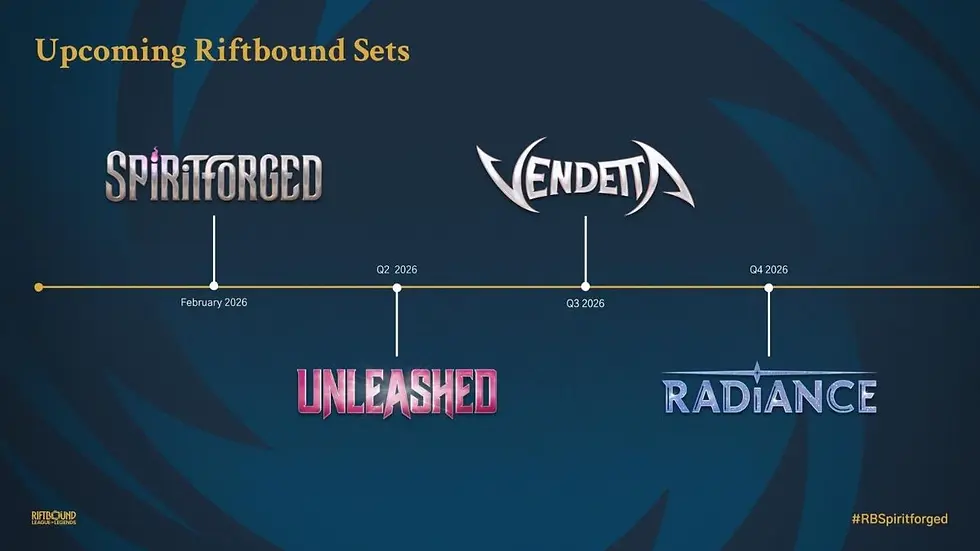
The release cadence hasn't slowed down either. Origins launched the game in October, Spiritforged followed in February, Unleashed landed in the spring, Vendetta releases this month, and Radiance closes out the year on October 23. That's a full main set roughly every three months, matched with starter decks built around individual League of Legends champions.
What Riftbound does that Magic doesn't
A few design choices explain why the game caught on this fast, and they're worth understanding on their own terms before we get to how they stack up against Magic. Riftbound supports 1v1, 2v2, and free-for-all play using the exact same card pool and deck-building rules from day one, no separate format with its own banned list, no card pool split between casual and competitive play. Its rune-based resource system replaces lands entirely, which cuts down on the kind of mana screw that's frustrated new Magic players for decades. Entry cost is lower too, a single Champion deck runs well under what a Magic Commander precon costs, and competitive-viable decks are still cheap enough that new players aren't priced out early. On top of that, the card stock and production quality have drawn real praise from collectors who have picked up TCGs' new darling.
The built-in audience matters just as much as the design. League of Legends brings millions of existing players, and Arcane's crossover success on Netflix pulled in collectors who never touched a keyboard in their life. Signature cards for champions like Kai'Sa, Jinx, and Teemo have already reached four figures on the secondary market, backed by an organized play structure that includes Regional Qualifiers and tournament prize pools in the tens of thousands. Sound familiar? It should. Swap League of Legends for Disney and Arcane for the animated classics, and you're describing Lorcana's exact playbook from 2023.
So does that mean history just repeats itself?
Mostly, and that's actually good news for anyone worried about MTG. Lorcana never dethroned Magic. It became the third or fourth biggest thing in the hobby, a genuinely healthy, well-loved game with its own dedicated player base, sitting comfortably next to Magic instead of on top of it. Yu-Gi-Oh did the same thing decades earlier and never stopped. Pokemon did it too. The real pattern looks less like "new game shows up, and Magic loses" and more like "new game shows up, has an incredible first year, and the hobby gets a little bigger for everyone."

The people who cover both games closely see the same pattern forming with Riftbound. One review framed Riftbound as entering Magic's market rather than challenging it directly, predicting it would end up sitting alongside mid-tier competitors like One Piece, Star Wars: Unlimited, and the Final Fantasy TCG rather than pulling meaningfully from Magic's base. Draftsim's comparison piece put it even more directly, describing Magic as too large and too established to be threatened by any single new entrant, Riftbound included.
There's also a wrinkle worth zooming in on: one analysis pointed out that Riftbound's biggest long-term risk is the sheer number of card games now competing for the same limited pool of store shelf space, player time, and disposable income, not Magic specifically. Riftbound has to fight through that increasingly crowded field just as hard as anyone else does.
The real lesson for Magic is structural, not competitive
Here's what actually matters, and market share has surprisingly little to do with it. Riftbound built genuine format flexibility into its foundation. Magic has never done that. Commander and Constructed run on entirely different deck-building rules and ban lists, and I've already made the case that Magic's own casual format gap sits with groups of three or more players, a space Commander covers and Constructed doesn't really touch at all. Riftbound didn't need to solve that problem after the fact. It designed around it from the start.
That's not a reason to panic, and if you've been around this hobby long enough to remember Lorcana's launch week, you already know how this particular story tends to end. It's a reason to pay attention. A new competitor proving that flexible, one-deck multiplayer design is possible, and that players respond to it, is exactly the kind of signal Magic's format team should be studying closely, whether or not Riftbound ever pulls a single player away from a Commander table. The question is less "Should Magic: The Gathering be afraid of Riftbound" and more, "What can Magic: The Gathering learn from its newest neighbor?"

Author:
Greg is the founder of The Cardboard Chronicles, covering mostly Magic: The Gathering, but dabbling in Pokemon, Lorcana, Elestrals, and many more of the world's popular TCGs. Greg has been playing and collecting Magic: The Gathering and Pokemon for over 2 decades and covers the TCG space daily while running all of the social channels!
Should Magic: The Gathering be afraid of Riftbound FAQ
Is Riftbound a threat to Magic: The Gathering?
Not existentially. Most industry analysis suggests Riftbound is more likely to compete with mid-tier TCGs like One Piece and Star Wars: Unlimited than to meaningfully pull players away from Magic's established base.
How fast did Riftbound grow after launch?
Very fast. Daily searches jumped over 300% compared to the preorder period, marketplace listings grew from roughly 68,600 to over 585,000 within a month, and the game became one of TCGplayer's top-selling product lines within weeks of its October 2025 launch.
What makes Riftbound different from Magic: The Gathering?
Riftbound uses the same card pool and deck-building rules across 1v1, 2v2, and free-for-all play from day one, uses a rune-based resource system instead of lands, and generally costs less to enter competitively than Magic.
How often does Riftbound release new sets?
Roughly every three months. Origins launched in October 2025, followed by Spiritforged, Unleashed, Vendetta, and Radiance, which closes out the 2026 release calendar on October 23.
Why don't experts consider Riftbound an "MTG killer"?
Magic's three-decade history, format depth, and player investment give it a scale new entrants can't replicate quickly. Most coverage instead frames Riftbound as more likely to compete with newer, mid-tier trading card games for the same growing audience.
What is Riftbound's biggest long-term challenge?
According to industry analysis, it's not competition with Magic specifically, it's the overall saturation of the trading card game market, where every game is competing for the same limited store shelf space, player time, and spending.
What should Magic actually learn from Riftbound's rise?
The clearest lesson is structural rather than competitive: Riftbound built multiplayer format flexibility into its core design from launch, something Magic has never done by keeping Commander and Constructed on separate card pools and rules.


Comments