
Unbalanced | Building Your Witherbloom, the Balancer Commander Deck

Updated: Apr 24
They named this card Witherbloom, the Balancer. They looked at an Elder Dragon that reduces the cost of every instant and sorcery in your entire deck based on how many creatures you control, decided that was a reasonable thing to print, and then called it "the Balancer". Bold choice. Much respect.
A Witherbloom, the Balancer Commander deck is, at its core, about doing two things simultaneously that most green-black decks already want to do anyway: putting lots of creatures on the battlefield and casting expensive spells. The difference is that here, the creatures are not the plan. They are the discount mechanism. The spells are the plan. And with enough creatures in play, those spells cost almost nothing.
Note: Witherbloom, the Balancer releases with Secrets of Strixhaven on April 24, 2026.
What Does Witherbloom the Balancer Do?
Witherbloom the Balancer costs 6BG for a 5/5 legendary Elder Dragon with flying and deathtouch. It has affinity for creatures, meaning it costs one less to cast for each creature you control. And then it reads: "Instant and sorcery spells you cast have affinity for creatures."

That second line is the entire deck. Every instant. Every sorcery. All of them get cheaper by one mana for each creature you have on the battlefield. Cast a Torment of Hailfire with twelve creatures in play, and you are effectively getting twelve free mana toward whatever X turns out to be. Cast a Finale of Devastation, and the X value is whatever your creature count allows. Affinity only reduces generic mana costs, so you will always pay the colored pips, but Golgari has two colored pips and a lot of colorless mana in most of its best spells.
The other thing worth knowing is that affinity applies to the Commander tax. Every time Witherbloom dies and comes back from the command zone, those extra two mana get eaten by the creature count on your board. Kill it twice, and it still comes back for two mana if you have eight creatures. Which, in this deck, you will.
Why Is the Witherbloom, the Balancer Commander Deck Cool?
Golgari decks usually pick a lane. You are either going wide with tokens, running a sacrifice engine, grinding the graveyard, or draining life. Witherbloom, the Balancer does something genuinely different. It takes the creatures you were going to play or generate anyway and turns them into a mana discount mechanism for the most expensive spells in the format. Your board is not the win condition. It is the engine that makes the win condition cheap or free.
That is a design space that green-black has never occupied quite like this before. Most creature-heavy commanders want you to attack with your creatures, sacrifice them, or trigger abilities off them. Witherbloom just wants them to exist. Stand there. Be creatures. Their presence alone is enough to transform your hand full of expensive sorceries into near-free haymakers that end games. Every mana dork, every Saproling, every copy of Scute Swarm that multiplied itself across four turns is quietly doing accounting work in the background so that when you tap out for Torment of Hailfire, the number after X makes everyone at the table look at their hand and cry.
A commander that opponents have a hard time permanently answering, that discounts itself back into play on the command tax, and that makes two of the most historically loved mechanics in Magic history cooperate with each other is not balanced.
Early Game Strategy: Build the Board First
The Witherbloom, the Balancer Commander deck has a very clear early-game priority, and it is not ramping with spells. It is ramping with creatures. Mana pals are your best friends here because every one of them pulls a double. They accelerate you toward Witherbloom, and they add a creature to the board that reduces your future spell costs.

Birds of Paradise, Llanowar Elves, and Elvish Mystic are your turn-one plays. None of them are exciting. All of them are load-bearing. The goal is to have four or more creatures in play by the time Witherbloom lands, and each of these costs one mana and occupies a creature slot on the battlefield for hopefully the rest of the game. Birds of Paradise earns a slight edge over the Elves variants because the flying body has a better chance of surviving long enough to matter in combat, and the mana fixing is always welcome in a two-color deck.
Sol Ring and Arcane Signet still earn their spots because you need the colored mana consistently, but the bulk of your early acceleration should be creature-based wherever possible. Artifacts do not feed the affinity reduction. Creatures do.
Beast Whisperer is worth dropping as early as turn three if you have it. Whenever you cast a creature spell, draw a card. In a deck trying to flood the board with mana dorks, tokens, and utility creatures, Beast Whisperer turns every creature you play into a cantrip. The early game is supposed to be about building the board, but running out of gas before Witherbloom lands is a real problem. Beast Whisperer helps keep your hand full while you do it.
Skullclamp is the other early play worth thinking about. Equip it to any one-one token, and it immediately dies, drawing you two cards. In a deck generating Saprolings from Sprout Swarm, insects from Scute Swarm, and Squirrels from Chatterfang, Skullclamp turns every token that would otherwise trade off or die to a board wipe into two cards. It also works with your mana generators when they have outlived their usefulness late in the game.
Turns one through four are creature deployment and hand refueling. Turns five through six are when Witherbloom comes down at a meaningful discount and immediately starts transforming your hand full of expensive spells into near-free interaction.
Mid Game Strategy: Snip Snap Snip Snap
Once Witherbloom is in play the deck does something that most Golgari builds do not get to do. It turns its creature count directly into spell efficiency. Every token you create, every cheap creature you drop, every attacker that survives combat makes your next instant or sorcery cheaper.
Scute Swarm is one of the most powerful mid-game pieces in the entire deck. A three-mana creature that copies itself every time a land enters your battlefield. In a normal Scute Swarm game, the copy chain gets out of hand fast. In a Witherbloom Commander deck, each copy is also a point of generic mana reduction on every spell you cast. A board with twelve Scute tokens and Witherbloom in play is a board where most of your instants and sorceries cost 2 or less.
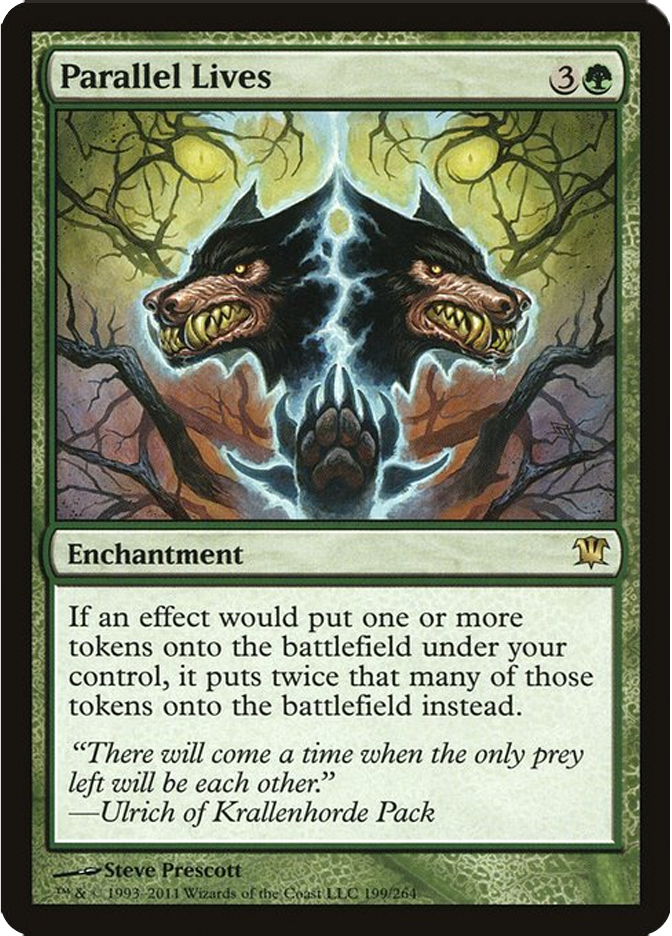
Parallel Lives doubles every token you create. Sprout Swarm makes two Saprolings instead of one. Scute Swarm makes two copies per land drop instead of one. Everything accelerates faster toward the creature count that makes your spells nearly free. Parallel Lives does not make any creatures itself. Still, it doubles the rate at which your token generators build the discount engine, and in a deck where every creature is a reduction point that compounds into spell efficiency, doubling your token production is effectively doubling your mana discount rate.
Chatterfang, Squirrel General is a three-mana green legendary Squirrel Warrior from Modern Horizons 2 with Forestwalk and a passive that creates a matching number of 1/1 green Squirrel tokens alongside every other token you create. Whenever you make a Saproling from Sprout Swarm, you also make a Squirrel. Whenever Scute Swarm makes a copy, Chatterfang makes a Squirrel alongside it. Every token-generating effect in the deck gets mirrored into the Squirrel army.
Demonic Tutor belongs in this section because the mid-game is when you need to find the piece that closes everything out. Two mana, search your library for any card, and put it in your hand. In the mid-game, this is usually Sprout Swarm if you do not have it, Scute Swarm if the engine is stalling, or whatever the table demands. Later in the game, it is Torment of Hailfire or Finale of Devastation. Demonic Tutor in Golgari is always good, but it is particularly good in a deck where the difference between finding the right card and not finding it is the difference between going infinite on turn seven and spending two more turns doing setup.
Late Game Strategy: Cash In the Board
By the time the late game arrives, your board should be wide enough that most of your spells cost BG or close to it. This is when you start pointing expensive sorceries at the table and watching opponents try to deal with what is happening.

Phyrexian Altar is the piece that converts your infinite Sprout Swarm token chain into infinite mana. Sacrifice a creature, add one mana of any color. With infinite tokens coming in at instant speed, Phyrexian Altar generates infinite mana of any color combination you need. This transforms the Sprout Swarm combo from producing infinite tokens into producing infinite mana, which then feeds into Torment of Hailfire, Finale of Devastation, or any other X spell for the kill. Without Phyrexian Altar, the combo still wins through token volume. With it the win is cleaner and more immediate.
Torment of Hailfire is the premier late-game closer in the Witherbloom, the Balancer Commander deck. Affinity can help pay for X on a spell. With twelve creatures in play, it costs BG plus whatever X you want it to be, because all twelve points of generic mana discount are going straight into X. Each opponent has to sacrifice X permanents, discard X cards, or lose three life per iteration they do not fulfill. An X of ten or more is lethal against most opponents in a single casting. With Witherbloom on the table and a full board, Torment of Hailfire casting for X of twelve or fifteen is not a late-game pipe dream. It is a realistic turn eight or nine line.
Finale of Devastation is the other closer worth knowing. Search your library or graveyard for any creature with mana value X or less and put it onto the battlefield. If X is ten or more, all your creatures get plus X plus X and haste. With Witherbloom discounting the spell by your creature count, reaching a massive X is trivial in the late game, and the secondary effect of pumping your entire board into an unblockable alpha strike closes games on the spot.
5 Must-Include Cards for Your Witherbloom, the Balancer Commander Deck
Sprout Swarm
Sprout Swarm is a one green mana instant from Future Sight with two keywords that were clearly not designed to be on the same card: Convoke and Buyback. Convoke lets your creatures help pay for the spell. Buyback three lets you return it to your hand when it resolves for an additional three mana. Create a one-one green Saproling creature token.

With four or more creatures in play, Witherbloom discounts Sprout Swarm's total cost, including the Buyback, to zero. You cast it, tap one creature to pay the Convoke cost, it resolves, you get a Saproling token back, and the spell returns to your hand because the Buyback cost was fully covered by affinity. You cast it again using the new token to Convoke. Infinite tokens. At instant speed. On any opponent's end step. The entire combo costs one green mana to start and nothing after that. This is the one-card infinite combo in the command zone that the cEDH community is already extremely upset about.
Scute Swarm
Scute Swarm is a three-mana green creature from Zendikar Rising that creates a copy of itself every time a land enters your battlefield, provided you already have six or more lands. In a normal deck, this turns into a board of exponentially multiplying insects very quickly. In a Witherbloom, the Balancer Commander deck, each copy is also a one-mana reduction on every instant and sorcery you cast, compounding the board state into a discount engine that eventually makes your entire spell suite functionally free.

The interaction between Scute Swarm and Witherbloom is the backbone of the mid-game plan. You do not need to do anything special to set it up. Play lands, make copies, watch the discount meter climb. By the time you have eight Scute copies in play alongside Witherbloom and a handful of mana dorks, you are casting Torment of Hailfire for X of fifteen off BG and some pocket change.
Chatterfang, Squirrel General
Chatterfang, Squirrel General is a three-mana green legendary Squirrel Warrior from Modern Horizons 2. Whenever one or more tokens would be created under your control, those tokens plus that many 1/1 green Squirrel tokens are created instead. It also has an activated ability: pay one black mana and sacrifice X Squirrels, and target creature gets +X/-X until end of turn.

In a Witherbloom deck built around creature count as an engine driver, Chatterfang does not just match your tokens. It doubles them. A board that would have given you eight points of affinity reduction now gives you sixteen. The activated ability is also worth noting for its actual function: it is a single-target pump or shrink effect, not a board wipe. Sacrifice ten Squirrels, and a problem creature becomes a zero-toughness creature that dies immediately. With infinite Squirrels from the Sprout Swarm combo, you can shrink any number of individual creatures to zero toughness one at a time, clearing the board over multiple activations at instant speed.
Torment of Hailfire
Torment of Hailfire costs XBB, and for each iteration of X, each opponent must sacrifice a non-land permanent, discard a card, or lose three life. There is no choosing zero of the above. Every opponent faces X individual decisions where every option is bad. At X of eight, which is extremely reachable in this deck, opponents are sacrificing eight permanents or losing twenty-four life or some combination of the two.

Torment of Hailfire is the natural closer for the Witherbloom, the Balancer Commander deck, because the two black pips are the only fixed cost, and everything else is variable. With twelve creatures in play, Witherbloom gives you twelve free generic mana toward X. You tap out for whatever BG can get you in additional mana and watch X become a number that ends the game. No combat required. No attacking required. Just a sorcery pointing at the table with X set to whatever number of creatures you have managed to accumulate.
Finale of Devastation
Finale of Devastation costs XGG and searches your library and graveyard for a creature with mana value X or less, putting it directly onto the battlefield. If X is ten or more, all creatures you control get +X/+X and gain haste until end of turn. This is your second closing line and your best recovery tool after a board wipe.

The reason Finale of Devastation belongs in every Witherbloom, the Balancer Commander deck is that it functions as both a tutor and a win condition simultaneously. Early in the game, you use it with a small X to find whatever creature the situation demands, Scute Swarm to start the token engine, Chatterfang to double everything, or Witherbloom itself if it was countered and needs to be found from the library. Late in the game, with your creature count discounting the cost down to near zero, X naturally becomes a double-digit number, and your entire board swings in with a massive power boost and haste for what is typically a one-shot kill.
Is A Witherbloom, the Balancer Commander Deck for You?
A Witherbloom, the Balancer Commander deck is for the player who wants to combine two things in Golgari that were never really supposed to work together this well: a board full of creatures and an arsenal of expensive spells that become cheap because of those creatures. It is not a sacrifice deck. It is not a life gain deck. It is a creature-fueled spell reduction engine that turns Golgari's natural tendency to go wide into a discount mechanism for the most powerful sorceries in the format.
Load up on your mana-producing friends, find Sprout Swarm early, let Scute Swarm and Chatterfang multiply the board, and then cast Torment of Hailfire for a number that makes the table quietly put their cards back in the box. The name says Balancer. The card says otherwise.


Comments